

Cruise Transfers
Portland to Pier 91 Alaska Cruise Transfer.
Smith Cove's Pier 91 is where Seattle's Alaska season begins, the home dock for Holland America, Princess, Norwegian, Carnival, and Royal Caribbean on the Inside Passage and Glacier Bay runs. Getting there from Portland, Oregon means 175 miles up I-5, roughly three hours door-to-dock from a downtown Portland or Vancouver WA hotel, with the Joint Base Lewis-McChord stretch as the one variable that can stretch it. What follows is the boarding-day playbook for couples and small groups making that run against a fixed all-aboard deadline, cruise luggage and all.
By Ilyas KhairiFounder, Marquee ChauffeurLicensed and permitted since 2018
- Licensed & Permitted
- $1M Insured
- 5.0 / 198 Reviews
- W-2 Chauffeurs
- 35-Point Inspection
Last updated: September 14, 2026
By Ilyas Khairi, Founder of Marquee Chauffeur · Licensed and permitted since 2018 · Updated September 14, 2026
TL;DR
Portland to Pier 91 is 175 miles up I-5, about three hours door-to-dock, into a boarding window that usually runs 11 a.m. to 3 p.m. The Escalade ESV ($135/hr) is the default for a couple with cruise luggage; the Sprinter ($165/hr) covers three or more couples. The chauffeur builds the departure clock around the JBLM bottleneck, drops at the Smith Cove curb inside the window, and clears once the porters take the bags.
Service overview on cruise terminal transportation; corridor mechanics on Portland to Seattle private car service. Dispatch: (503) 706-8662.
01 The Booking Pattern
PDX Arrival, Portland Hotel,
Pier 91 Boarding Morning.
Nearly every Pier 91 booking follows the same shape: fly into PDX a day ahead, sleep in a Portland or Vancouver WA hotel, and run to the dock the next morning. The logic is margin. Alaska sailings open boarding around 11 a.m. to 3 p.m. and set the all-aboard cutoff about 90 minutes before departure, and stacking a long flight, a 175-mile freeway push, and a hard deadline into one day leaves almost no room for error. A hotel night breaks that stack in two and puts the chauffeur at Smith Cove with cushion to spare.
The pre-cruise leg opens with a PDX airport pickup on the inbound flight. FlightAware feeds live wheels-down data into Marquee dispatch, so a delayed flight shifts the chauffeur's arrival to the new landing time, with no meter running on the wait. From there it is the hotel, cruise luggage handed to the bell desk, and a confirmed boarding-morning pickup window before the chauffeur clears. Most riders fold the PDX leg, the overnight, and the Pier 91 run into one engagement so the same chauffeur, vehicle, and luggage routine carry through the whole trip.
Come boarding morning, the chauffeur is at the hotel valet at the agreed time, loads the bags from the bell desk without the rider lifting anything, and points the car up I-5. The aim is to reach Smith Cove 30 to 45 minutes ahead of the rider's preferred check-in slot, comfortably inside the window and well clear of the all-aboard cutoff. Both the Escalade ESV and the Sprinter swallow cruise luggage without stacking it on seats, and the cargo stays locked at every stop along the way.
Day-before PDX arrival
Flying into PDX the day before sailing? Book the airport pickup, the hotel transfer, and the boarding-morning Pier 91 run as one engagement. The chauffeur carries you from PDX to a downtown Portland hotel, The Nines, the Heathman, the Sentinel, or to the Heathman Lodge in Vancouver WA, and the cruise bags go to the bell desk that night. Next morning the car pulls from the same valet curb, no repacking required.
Same-day PDX arrival
A same-day PDX-to-Pier-91 transfer works when the inbound lands by mid-morning and boarding opens early afternoon. Measured from the airport gate, PDX to Pier 91 is 190 miles, plan four hours door-to-dock to absorb the curbside transition and the JBLM corridor. For any 7-day Alaska itinerary we still steer riders to the day-before structure, because a missed connection or weather delay on a same-day run leaves no recovery margin against the all-aboard cutoff.
Vancouver WA hotel start
Vancouver WA pickups cover the Heathman Lodge, the Hilton Vancouver Washington downtown, and the AC Hotel Vancouver Waterfront for a Columbia River view the night before. From the Vancouver cluster it is about 2 hours 50 minutes to Pier 91, roughly ten minutes quicker than a downtown Portland start, since the northbound entry skips the river crossing. We absorb the cross-river leg with no state-line surcharge and run the same flat-rate meter from the Vancouver valet to Smith Cove.
Round-trip booking
A round-trip Pier 91 booking keeps the same chauffeur and vehicle across both legs, pre-cruise on boarding morning, post-cruise on the disembarkation morning seven days later. Most riders pair the return with a downtown Portland hotel night and a separate next-morning PDX run rather than a same-day Pier 91-to-PDX dash, which sidesteps tight margins on the southbound JBLM window. One engagement, with the luggage routine locked end to end.
02 The Corridor
I-5 North, JBLM Window,
And The Departure Clock.
The route runs I-5 North out of Portland through Vancouver WA, Kelso-Longview, Centralia, Chehalis, and Olympia, past the Joint Base Lewis-McChord stretch around DuPont, then through Tacoma and into Seattle to Smith Cove. Boarding-day mornings northbound usually clear by 10 a.m. and run smoothly to Tacoma. The real pressure on this transfer is the southbound disembarkation return, not the boarding push, but the chauffeur still builds the morning clock with JBLM in mind, so a late inbound flight or a slow valet does not snowball into a late Pier 91 arrival.
JBLM is the corridor's dependable choke point. The base hugs I-5 between Tacoma and Olympia, and gate traffic stacked on commute traffic squeezes the freeway in known windows, northbound 6 to 8 a.m. adds 20 to 40 minutes, southbound 3 to 7 p.m. adds 30 to 60, and the Tacoma Dome S-curves pile their own merge on top in the same hours. Marquee plans the departure around that published pattern rather than into it, which usually means leaving Portland earlier when the boarding window opens after noon. The same logic drives the southbound return, covered for the non-cruise context on the Portland to Seattle private car service page.
Weather and reroutes sit on top of that math. Winter fog through the Chehalis flats or a summer brush closure near Kelso can push traffic onto SR 500 or secondary arteries, and every Marquee chauffeur carries the corridor knowledge to adapt with dispatch when it does. The S90, Escalade ESV, and Sprinter all run the route comfortably with one optional rest stop near Centralia or Olympia. Pre-cruise riders rarely take it, the boarding clock rules, while post-cruise riders take it more often, since the return timeline is downstream of the disembarkation clear time.
Northbound boarding-day window
A 7:30 a.m. departure from a downtown Portland hotel for a 1 p.m. Pier 91 slot reaches Smith Cove around 10:30 a.m. with cushion; a 9 a.m. start for a 2 p.m. slot lands near noon. The chauffeur checks WSDOT and ODOT TripCheck before leaving the garage and adjusts mid-transit if the JBLM stretch flags congestion. Most boarding-day runs finish inside the three-hour planning window without timeline stress.
Southbound JBLM return
Disembarkation-morning returns aim to clear the Tacoma-JBLM stretch before the 3 p.m. southbound window opens. A 9 a.m. Pier 91 pickup lands a Portland drop around noon; a 10:30 a.m. pickup lands near 1:30 p.m. The afternoon window is the route's worst stretch southbound, so we pull the disembarkation pickup toward the front of the morning whenever the cruise line's published clear time allows.
Centralia or Olympia rest stop
The corridor allows one optional rest stop near Centralia or Olympia, usually a ten-minute break at the rider's request. The S90, Escalade ESV, and Sprinter all carry bottled water and a small cooler. Pre-cruise riders skip it for the boarding clock; post-cruise riders take it more often, since the disembarkation morning starts early enough that a coffee break is welcome.
Official terminal resource
To confirm the Smith Cove terminal layout, the cruise-line building assignments, or the drop-curb rules, riders can check the Port of Seattle cruise page, which covers the Smith Cove Cruise Terminal at Pier 91. Marquee dispatch routes against the building assignment printed on your cruise documents.
03 Pier 91 At Smith Cove
The Drop Curb, The Porter Handoff,
And The Cabin Tag Confirmation.
Pier 91 sits on Elliott Bay at Smith Cove, with a dedicated cruise-terminal drop lane kept separate from the Port of Seattle's container-yard traffic. The chauffeur stages in that lane at the right terminal building, Holland America, Princess, Norwegian, Carnival, or Royal Caribbean, according to your boarding documents. Each line has its own building on the Smith Cove campus, printed on the boarding pass and shown in the cruise-line app, so the chauffeur reaches the correct one on the first pass.
Porters meet the vehicle at the curb, lift the cruise luggage straight from the cargo area, and hand back a porter receipt with your cabin tags attached. Those tags are pre-printed in your online check-in profile and travel with the bags from curb to cabin, you never route them through the terminal queue. Tipping the porter is a passenger-direct transaction at the industry-standard two dollars per bag. The whole process is coordinated so nothing is left in the vehicle and you walk toward the terminal with only your carry-ons.
Curbside time runs eight to twelve minutes depending on the boarding-day queue. The chauffeur confirms the cabin-tag count with you before pulling away, catching any bag-count mismatch while the car is still at the curb rather than after you have crossed into the building. Once the handoff is done and you have started for the entrance, the chauffeur clears the lane and departs; Pier 91 does not allow extended idle for private vehicles during the 11 a.m. to 3 p.m. window, so the car does not hold curbside through check-in. Dispatch stays reachable by phone if anything turns up missing.
04 The Vehicle Match
Cruise Bags, Couples Per Vehicle,
And The Sprinter Threshold.
Cruise passengers pack heavier than air travelers. A couple on a 7-day Alaska sailing usually reaches PDX with three or four large checked bags, two carry-ons, and a garment bag for formal nights; a three-couple Glacier Bay group stacks to ten or twelve full-size bags plus carry-ons, and a four-couple group crosses fourteen. Marquee sizes the vehicle to the bag count, not the seat count, the structural difference between a chauffeur fleet and a generic black-car booking that looks only at how many people are riding.
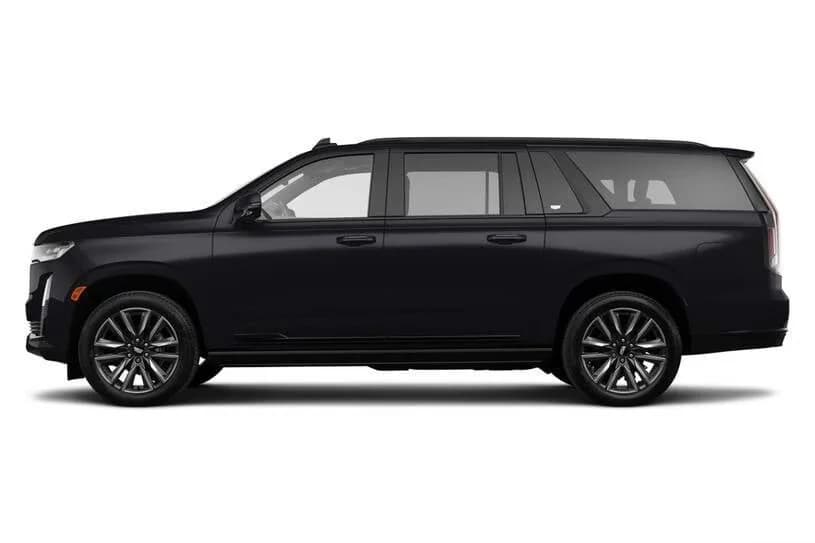
The Cadillac Escalade ESV at $135 per hour is the most-booked Pier 91 vehicle. Third row folded, it takes six or seven full-size cruise bags plus carry-ons for one or two couples with ease, and most couples cross the Volvo S90 sedan threshold the moment formal wear and Pacific Northwest layering go in. The Mercedes-Benz Sprinter at $165 per hour seats up to fourteen and holds up to fourteen full-size bags in its rear cargo segment, the right call for three or more couples. The full vehicle-class breakdown is on the Portland chauffeur pricing guide 2026.
Round-trip Pier 91 bookings run on a continuity-vehicle model: the same Escalade ESV or Sprinter holds across both legs. The chauffeur loads on boarding morning, runs the corridor, drops at Smith Cove, and reappears at the same terminal building seven days later for the disembarkation pickup, no vehicle or chauffeur cycling off in between. For groups that exceed Sprinter capacity, the Portland group transportation page covers the multi-vehicle structure.
Escalade ESV at $135 per hour
The most-booked Pier 91 vehicle. Seats six and takes six or seven full-size cruise bags with the third row folded, the default for one or two couples on a 7-day Alaska itinerary. The cargo floor is flat, garment bags lie without creasing, and oversize duffels fit without strapping. Holland America, Princess, Norwegian, Carnival, and Royal Caribbean passengers default to this class.
Sprinter at $165 per hour
For three or more couples with full cruise luggage. Seats up to fourteen and takes up to fourteen full-size suitcases plus carry-ons in the rear cargo segment, which is walled off from the cabin to keep bags stable across the I-5 corridor and the JBLM zone. Multi-couple Holland America and Princess Alaska group bookings default here.
Volvo S90 at $110 per hour
Fits a couple with two large checked bags and two carry-ons in the trunk, sometimes the right call for a shorter Norwegian or Royal Caribbean repositioning sailing that stays inside cruise-line baggage limits. Most 7-day Alaska couples cross the sedan threshold once formal wear and layering go in, so the Escalade ESV is the more common Pier 91 pick.
Continuity vehicle on round-trip
Round-trip Pier 91 bookings hold the same vehicle and chauffeur across the boarding-morning and disembarkation-morning legs. The luggage routine stays consistent, the cabin presets do not reset, and nobody gets reassigned at the curb. Sprinter and Escalade ESV continuity bookings should lock when the cruise reservation does, peak Alaska season fills the calendar early.
| Vehicle | Hourly rate | Cruise-bag capacity | Best for |
|---|---|---|---|
| Volvo S90 | $110 / hour | 2 checked + 2 carry-on | Couple, light load |
| Cadillac Escalade ESV | $135 / hour | 6-7 full-size + carry-ons | 1-2 couples (most booked) |
| Passenger Sprinter | $165 / hour | Up to 14 full-size + carry-ons | 3+ couples |
Flat-rate quote locks at booking with no surge. Marquee holds Portland Bureau of Transportation certification (continuous since 2018, with Washington reciprocity) and $1 million commercial liability on every cross-state ride.
“Used them to get from PDX to about two hours away and back a few days later. On time. Super professional drivers. Vehicles in spectacular shape. Our go-to service.”
Frequently Asked
Questions, Answered.
How much does a Portland to Pier 91 one-way cruise transfer cost?
The one-way Portland-to-Pier-91 transfer is built on the locked hourly rate plus the round-trip drive time the chauffeur spends on the corridor. The Cadillac Escalade ESV at $135 per hour is the most-booked vehicle for couples-plus-luggage, with a typical engagement landing between five and six hours once the boarding-window staging is included. The Mercedes-Benz Sprinter at $165 per hour covers groups of three or more couples with full cruise luggage. The Volvo S90 at $110 per hour fits a couple with light luggage, though most cruise riders cross the sedan threshold once a 7-day Alaska itinerary's bag count gets packed. Flat-rate quote locks at booking with no surge.
How long is the drive from Portland to Pier 91, and when does JBLM matter?
Portland to Pier 91 runs 175 miles north on I-5 with a three-hour planning window door-to-dock from a downtown Portland or Vancouver WA hotel. The Joint Base Lewis-McChord stretch around DuPont is the route's reliable bottleneck. Northbound boarding-day mornings typically clear by 10:00 a.m., but southbound returns from 3:00 to 7:00 p.m. add 30 to 60 minutes of base and commute volume on top of the Tacoma Dome merge. We build the departure clock around the JBLM window rather than against it, which usually means leaving Portland earlier rather than later when the boarding tide is mid-afternoon.
Can I book a round trip covering both pre-cruise and post-cruise transfers?
Yes. The cleanest pattern is two separate one-way bookings with the same chauffeur and vehicle locked for both legs. The pre-cruise leg runs Portland-to-Pier-91 on the morning of boarding day. The post-cruise leg runs Pier-91-to-Portland on the disembarkation morning seven days later. Most riders also pair the post-cruise leg with a downtown Portland hotel night and a separate next-morning PDX run rather than a same-day Pier 91 to PDX dash, because the southbound JBLM window often eats the margin on a same-day flight back. We hold the booking under one engagement so the chauffeur, vehicle class, and luggage protocol stay consistent across both legs.
What does the Pier 91 drop curb at Smith Cove actually look like?
Pier 91 sits on Elliott Bay at Smith Cove with a dedicated cruise-terminal drop lane separate from the Port of Seattle's container yard. The chauffeur stages in the designated lane at the Holland America, Princess, Norwegian, Carnival, or Royal Caribbean terminal building per your boarding documents. Porters meet the vehicle at the curb, take cruise luggage straight from the cargo area, and hand you the porter receipt with your cabin tags attached. Total curbside time runs eight to twelve minutes depending on the boarding-day queue. Tipping the porter is a passenger-direct transaction at the industry standard of two dollars per bag.
Can the chauffeur stage at Pier 91 during boarding in case we need anything?
No. Once the porter handoff is complete and you have walked toward the terminal entrance, the chauffeur clears the drop lane and departs. Pier 91 boarding-day curb access is regulated by the Port of Seattle and the cruise lines, and the staging zones around Smith Cove do not allow extended idle for private vehicles during the 11 a.m. to 3 p.m. boarding window. We confirm the cabin tag count before pulling away from the curb and stay reachable by phone if anything is missing, but the chauffeur does not hold curbside through your check-in.
How does disembarkation morning timing work on the post-cruise leg?
Disembarkation at Pier 91 typically clears between 7:30 and 9:30 a.m. on the cruise line's published schedule, with luggage hall flow stretching the actual on-curb pickup to 8:00 or 10:00 a.m. for most riders. The chauffeur stages near the terminal building at the announced time and stays flexible to your actual clear time. Early-walk-off passengers with carry-ons only land near the front of the window. Self-walk-off and standard-disembark groups clear later. We hold the same vehicle and chauffeur on the engagement, so the pickup window does not get reassigned at the curb.
How does the Pier 91 transfer compare to an Astoria cruise transfer?
Pier 91 and Astoria serve different itineraries. Pier 91 at Smith Cove is Seattle's primary cruise terminal for Alaska sailings on Holland America, Princess, Norwegian, Carnival, and Royal Caribbean Inside Passage and Glacier Bay routes. The Port of Astoria Pier 1 and Pier 3 cover Pacific Coast, Pacific Northwest, and Mexican Riviera itineraries on Holland America, Princess, Viking, and Norwegian. The right transfer depends on the embarkation port printed on your cruise documents, not on the cruise line. Same fleet and chauffeur protocol on both routes, with route-specific drive-time planning. The general overview lives on the cruise terminal transportation page.
Can a Sprinter handle four cruise bags per couple for a group of three couples?
Yes. The Mercedes-Benz Sprinter at $165 per hour seats up to fourteen and accepts up to fourteen full-size cruise suitcases plus carry-ons in the rear cargo area without stacking on seats. Three couples on a 7-day Alaska itinerary travel with twelve to fourteen large checked bags plus carry-ons and a garment bag for formal nights, which sits comfortably inside the Sprinter's threshold. The cargo segment is separated from the passenger cabin, keeping bags stable across the I-5 corridor and the JBLM zone. We size the vehicle to the bag count rather than the passenger count, so four couples or a heavily-packed three-couple booking still rides the Sprinter cleanly.
Can we book a Vancouver WA hotel pre-cruise overnight before the Pier 91 morning?
Yes. Vancouver WA hotel pickups run from the Heathman Lodge, the Hilton Vancouver Washington downtown, and the AC Hotel Vancouver Waterfront for guests who want the Columbia River view before the sailing. Pickup from the Vancouver hotel cluster runs about 2 hours 50 minutes to Pier 91 in normal conditions, which is roughly ten minutes faster than a downtown Portland hotel start because the I-5 northbound entry skips the bridge crossing. We absorb the cross-river leg without a state-line surcharge and run the same flat-rate hourly meter from the Vancouver valet curb to the Pier 91 drop.
Can you meet me at SeaTac if I fly into Seattle instead of Portland?
Yes, though the structural reason most cruise riders book through Portland is the pre-cruise overnight at a downtown Portland or Vancouver WA hotel paired with a morning Pier 91 transfer rather than a same-day SeaTac arrival into a same-day boarding window. SeaTac to Pier 91 itself runs about 25 to 35 minutes via SR-99 or I-5, well inside a normal hourly engagement. The Portland-paired pattern still wins for riders who fly into PDX or who prefer to stage out of a Portland hotel before the sailing. We can structure either side of that math, and the locked hourly rate holds across both Oregon and Washington under continuous Portland private-for-hire permitting with Washington reciprocity.
About the Author
Ilyas Khairi is the founder of Marquee Chauffeur, a Portland luxury black car and chauffeur service operating under Portland Bureau of Transportation certification since 2018 with $1 million in commercial liability coverage. He and his team of fully employed, background-checked chauffeurs run the Portland-to-Pier-91 cruise corridor through every Alaska season, on the boarding-day protocol described here.
Verified Google Reviews
What Portland clients say about Marquee Chauffeur.
I spent six hours touring the Columbia River Gorge with the owner of this service, and I was really impressed with his professionalism, attentiveness, and local knowledge. As he says, they really are like a chauffeur/concierge, not just taking you from one place to another but providing a full experience. I look forward to riding with them again on my next trip.
Edris — has absolutely hands down have to be the best driver ever. I would absolutely recommend his service! He's so professional, so efficient. On time and so respectful!
These guys are terrific. Two thumbs up. Found them online and got excellent personal service. Used them to get from PDX to about two hours away …. And then back to PDX a few days later. On time. Super professional drivers. Vehicles in spectacular shape. Brand new. They will be out go to service. We recommend them highly.
Marquee Chauffeur holds a 5.0 rating across 198 Google reviews. Read every review on Google.
Reserve Your Chauffeur
Reserve a Portland
Chauffeur Now.
Lock your Portland-to-Pier-91 Alaska cruise transfer. Call Marquee Chauffeur at (503) 706-8662, available 24/7. The Cadillac Escalade ESV at $135 per hour for couples plus full cruise luggage, the Mercedes-Benz Sprinter at $165 per hour for groups of three or more couples with the bag count cruise lines warn you about. JBLM-aware departure clock, Smith Cove drop curb, FlightAware on PDX inbound transfers, and Portland private-for-hire permitting held continuously since 2018 with Washington reciprocity on every cross-state ride. Book the Pier 91 morning and the disembarkation return under one engagement so the chauffeur, vehicle, and luggage stay locked across both legs.