

The Departures Shift
Portland Airport Drop Off Thirteen Planes Leave Before 5:50. We Meet Them All.
On the morning this guide was written, PDX launched thirteen aircraft between 5:00 and 5:50 a.m., four airlines airborne inside the first ten minutes, and every seat on every one of them got to the airport somehow in the dark. This is that somehow, narrated from the professional side: the sequencing that puts four households at their airlines by five, the upper roadway's five-minute constitution, the curb-dwell science transportation researchers actually measure, and the outer lane where permitted operators run a parallel system most travelers never notice.
By Ilyas KhairiFounder, Marquee ChauffeurLicensed and permitted since 2018
- Licensed & Permitted
- $1M Insured
- 5.0 / 198 Reviews
- W-2 Chauffeurs
- 35-Point Inspection
Last updated: September 23, 2026
By Ilyas Khairi, Founder of Marquee Chauffeur · Licensed and permitted since 2018 · Updated September 23, 2026
TL;DR
Drop-offs happen on the upper Departures roadway, active loading only, five-minute citation line, chauffeur stays with the car; walking someone in means the garage. The airport's own advice for the busy early mornings is two hours before domestic departures. Curbside research clocks private cars at about 3 minutes of dwell and professional sedans at 2.5, and permitted operators drop on the upper outer roadway under the Port's ground-transportation rules. The predawn bank is real: thirteen departures before 5:50 on the morning we counted.
The arrivals-side mirror of this shift lives on the pickup anatomy, the fleet-scale board behind it on the dispatch guide, and the cutoff clocks every drop-off races on the punctuality guide.
01 4:10 A.M.
The Board Says Thirteen,
And The Dark Says Go.
The shift begins with the board. On the live schedule the morning we wrote this, PDX's first wave ran: Seattle, Denver, and Las Vegas at 5:00 sharp on three different airlines, Dallas at 5:07, Chicago Midway at 5:10, San Francisco at 5:15, Phoenix and Sacramento at 5:20, two more at 5:30, Salt Lake at 5:45, Charlotte at 5:49, another Denver at 5:50, thirteen departures inside fifty minutes, every one boarding while most of the city slept. The airport's own travel guidance meets that bank with a plain instruction: during the busy early morning hours, arrive two hours before your domestic flight. Chain the arithmetic backward, two hours at the terminal, the drive, the doorbell, and the drop-off shift starts its engines a little after three.
Why the bank exists
The 5 a.m. wall of departures positions aircraft for full days of flying downstream, which means it never moves for weather, holidays, or anyone's preference for sleep. The bank is the fixed point; every household on tonight's run list is a variable being solved toward it.
The night-before sequence
Four bookings, four neighborhoods, one vehicle chain: West Linn at 3:20, Lake Oswego at 3:50, two Portland addresses after four, ordered so each household's two-hour target lands with margin. The sequencing logic is the dispatch board's craft, and the passenger-visible output is a headlight in the driveway at the agreed minute.
The empty-roads dividend
The predawn shift's one gift is the corridor: 3:40 a.m. freeways run at free-flow, so the drive times our guides compute apply almost literally, and buffers spend themselves on the terminal side where the bank's crowds actually live. The hard part of a 5 a.m. flight was never the road.
Who rides the first wave
Connection-builders, meeting-makers, and cheap-fare hunters: the 5 a.m. bank serves travelers whose day depends on being east by noon, which is why its drop-offs carry unmissable stakes by default. The shift treats every first-wave booking as the sacred slot our dispatch guide describes, because it is.
02 The Rules Of The Curb
Five Minutes, Loaded Or Cited,
And Nobody Walks Away.
The Departures roadway runs on a constitution the Port publishes in full. Its rules for the enplaning roadway, written in the airport rulebook, permit curb stops only for active loading, defined as all customers and their luggage at curbside next to the vehicle, with citations possible past five minutes; drivers who need to assist travelers, the rules add flatly, must remain within the vehicle at all times while using the terminal curbs, and unattended cars face citation and towing. The plain-language version on the airport's own tips page completes the picture: for the send-off that needs more than a curb hug, use the parking garage directly across the street and walk in like a civilized person. The curb is a valve, not a venue, and the morning's thirteen departures depend on it staying one. North county send-offs reach this curb by way of the final approach into PDX from Battle Ground.
The walk-in goodbye, done right
Elderly parents, nervous first-timers, kids flying to camp: the garage-and-walk-in send-off is the correct grade for them, with the airline's ticket-counter gate pass extending it past security when granted. The curb rule isn't hostile to tenderness; it just relocates it indoors, where it was always better anyway.
Dwell time, measured science
Transportation researchers actually clock this: the standard curbside study, ACRP's curbside operations report, models private cars at about 3 minutes of enplaning-level dwell and professional sedans at 2.5, and notes drop-offs run shorter than pickups across the board. The five-minute rule, in other words, is generous to everyone who arrived organized.
The organized unload
The professional two-and-a-half minutes is choreography, not hurry: bags loaded in exit order at the house, documents staged in pockets before the freeway, goodbyes substantially completed by the off-ramp. The curb receives a finished process, which is why it never feels rushed from inside the car.
Upper for going, lower for coming
The two-level grammar in one line: Departures above, Arrivals below, and the airport's own tips note the upper roadway typically runs less congested in the evening pickup hours, a legal wrinkle our methods audit explores from the arrivals side. For drop-offs the rule is simpler: up, unload, away.
03 The Outer Lane
Where The Permit Vehicles
Run Their Parallel Morning.
Watch the curb long enough and a second system resolves out of the traffic. The Port's ground-transportation chapter assigns permitted businesses their own geography, its rule reads that permitted operators may drop off customers only on the upper outer terminal roadway, keeping the inner curb for private cars, with the inner lane's accessibility drop-offs accommodated per the airport's ground transportation guidance. It is the departures-side sibling of the permit infrastructure our methods audit documented for arrivals: a managed lane, a known rhythm, professionals who run this curb a dozen times a week rather than twice a year. The practical difference shows in the dwell data and in the mornings themselves, the outer lane loads, releases, and returns to the freeway while the inner curb is still negotiating a trunk.
Our vehicles have run that outer lane since 2018: (503) 706-8662.
Why the lanes are split
Commercial vehicles run the terminal by the hundreds of thousands of trips a year, and separating practiced traffic from occasional traffic keeps both moving: the family sedan gets the door-adjacent curb, the professionals get predictable flow. Everyone's five minutes work better for the sorting.
The mobility exception
Travelers with mobility needs can be accommodated on the inner roadway per the airport's guidance, a detail that matters for exactly the bookings it describes: the drop-off where twenty fewer steps to the door is the entire point. The file records the need once; the curb choice follows automatically forever.
Check-in geography, one glance
The consolidated ticket hall sorts airlines into aisles, and the professional stop targets the stretch of curb nearest the traveler's counter, small positioning craft worth ninety seconds of walking with luggage. The airline's aisle is in the confirmation; the curb position follows from it.
When the morning wobbles
A 4 a.m. flat, a sick chauffeur, an oversleeping household: the shift absorbs its wobbles upstream, spare margin in the sequence, dispatch awake with the board, so the curb moment stays boring. Drop-off failures are almost always sequencing failures, and sequencing is precisely the purchased good.

04 5:15 A.M.
Four Households Delivered,
And The Shift Rolls On.
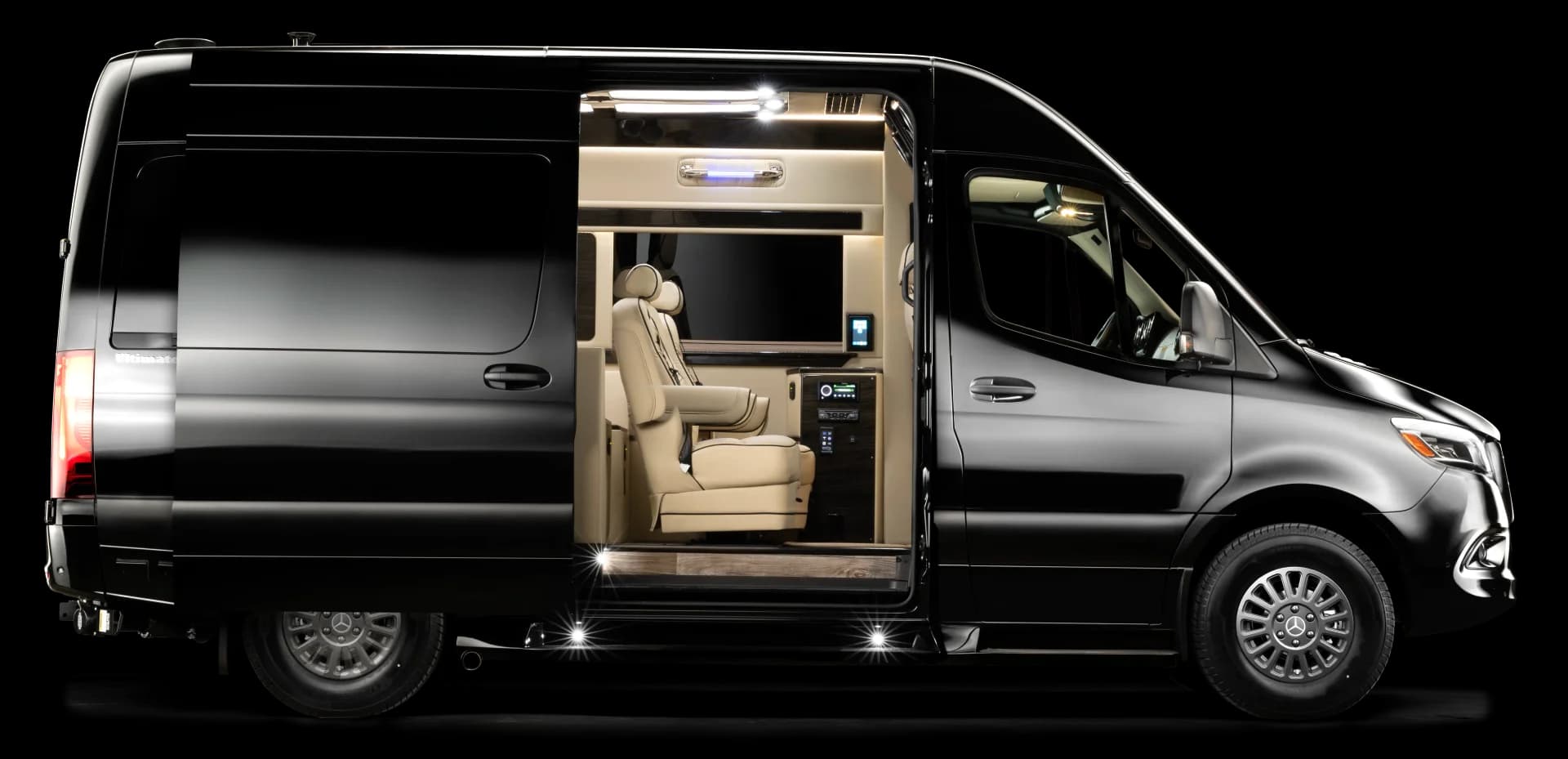
By quarter past five the shift's scoreboard reads four for four: the West Linn consultant at Alaska with his two-hour margin intact, the Lake Oswego couple at their aisle, the Portland families unloaded in their measured minutes, and thirteen aircraft lifting into the dark carrying all of them east. The vehicle that ran the chain turns toward its first arrival pickup of the day, the mirror shift our pickup anatomy narrates, and the drop-off morning closes the way professional mornings should: without a single memorable moment for any passenger involved. That is the product, priced flat, about $150 per household in the Volvo S90, $190 in the Escalade ESV, $326 in the Sprinter that can chain a whole traveling party's addresses into one run, with the punctuality arithmetic, the sequencing, and the outer lane included.
The group-chain option
A wedding party, a golf trip, a family reunion flying out together: the fourteen-seat Sprinter converts four separate predawn drop-offs into one sequenced pickup chain at one flat rate, and nobody's brother-in-law has to be the airport driver. Group departures are the shift's happiest arithmetic.
The round-trip file
Every drop-off implies a return: the same booking conversation sets the retrieval, flight-tracked with the grace window, so the trip's two hardest hours, the predawn departure and the eventual arrival, are solved as a pair. One call, both curbs, both directions of the same journey.
Honest cases for driving yourself
A midday flight, a short trip, a household with a willing driver and a two-car garage: drop yourself off and spend nothing, the curb rules in section two are all you need. The shift exists for the mornings that punish improvisation, the threes and fours on the clock, and it says so plainly.
The standing departure file
Frequent flyers keep the shift on retainer through Portland town car service: the usual first-wave flights, the preferred doorbell margin, the aisle their airline lives in. The 3:40 a.m. pickup becomes a standing appointment, which is the only civilized thing a 3:40 a.m. pickup can become.
Frequently Asked
Questions, Answered.
How do I drop someone off at the airport?
At PDX: follow signs for Departures to the upper roadway, pull to the curb outside your traveler's airline area, unload people and bags in one motion, and go, the roadway is active-loading only, with citations possible past five minutes and the chauffeur required to stay with the vehicle. Everything that needs longer, the walk-in goodbye, the check-in help, belongs in the parking garage across the street, which is the airport's own suggestion for exactly that.
How early should I get dropped off at the airport?
The airport's own guidance for the busy early morning hours is two hours before a domestic departure, and the predawn bank is precisely when that advice earns its keep: on the morning we narrate in this guide, thirteen aircraft left before 5:50 a.m. Work backward from two hours at the terminal, add the drive at your hour, and the doorbell time writes itself, which is the arithmetic our punctuality guide automates.
Can I go inside the airport without a ticket to drop someone?
Into the public terminal, yes, ticketing halls and pre-security areas are open to everyone, so you can park in the garage and walk a traveler to check-in or the checkpoint entrance. Past security requires a gate pass issued at the airline's ticket counter at its discretion, typically for minors and travelers needing assistance. The curb, by contrast, allows no accompaniment at all: the chauffeur stays with the car, by rule.
What time should I get to the airport for a 5:30 AM flight?
Around 3:30 a.m. at the terminal by the two-hour guidance, which puts the pickup at your door deep in the threes depending on your distance, an hour when rideshare supply is thinnest and self-driving means a week of airport parking. This is the exact scenario the predawn shift in this guide is built around: vehicles assigned the night before, staged early, sequenced so the 3:30 curb moment simply happens.
Where is the cell phone waiting area at PDX?
Off NE Airport Way near the terminal approach, built for the arrivals side of the equation: free short-term waiting while a flight lands, driver staying with the car. It plays no role in drop-offs, where the traveler leaves and the vehicle should too, but it earns a mention because the same families run both legs, and our red-eye guide covers its fine print for the midnight return.
What does a predawn drop-off to PDX cost?
The same as a midday one: about $150 in the Volvo S90, $190 in the Escalade ESV, and $326 in the Sprinter, flat-quoted with the 20 percent service fee inside and no night premium, because the predawn bank is this shift's standard work. Gratuity stays optional and is never added. A Sprinter chaining several households into one sequenced run splits its $326 across all of them.
How late can a 3:40 a.m. drop-off be added to the board?
Vehicles are assigned the night before, so the clean answer is: by the prior afternoon, with 24 to 48 hours the comfortable standard and more during holiday weeks when the predawn bank swells. That said, dispatch at (503) 706-8662 answers around the clock and places same-night requests when a vehicle and chauffeur are free, since the sequencing margin is built upstream of the doorbell.
About the Author
Ilyas Khairi runs Marquee Chauffeur under Portland Bureau of Transportation certification held since 2018, with $1 million in commercial liability and W-2 chauffeurs on payroll. He has driven the predawn shift more times than any reasonable person should admit, considers the 2.5-minute professional dwell time a point of pride, and believes the highest form of the 4 a.m. drop-off is one nobody in the car will remember by lunch.
Verified Google Reviews
What Portland clients say about Marquee Chauffeur.
I spent six hours touring the Columbia River Gorge with the owner of this service, and I was really impressed with his professionalism, attentiveness, and local knowledge. As he says, they really are like a chauffeur/concierge, not just taking you from one place to another but providing a full experience. I look forward to riding with them again on my next trip.
Edris — has absolutely hands down have to be the best driver ever. I would absolutely recommend his service! He's so professional, so efficient. On time and so respectful!
These guys are terrific. Two thumbs up. Found them online and got excellent personal service. Used them to get from PDX to about two hours away …. And then back to PDX a few days later. On time. Super professional drivers. Vehicles in spectacular shape. Brand new. They will be out go to service. We recommend them highly.
Marquee Chauffeur holds a 5.0 rating across 198 Google reviews. Read every review on Google.
Reserve Your Chauffeur
Reserve a Portland
Chauffeur Now.
Put the predawn shift on your side of the alarm clock: (503) 706-8662, available 24/7. Portland drop-offs at about $150 in the Volvo S90, $190 in the Escalade ESV, $326 in the Sprinter, flat-quoted with night-before vehicle assignment, sequencing built to the two-hour guidance, the outer-roadway craft, and the return pickup bookable in the same call, under Portland private-for-hire permitting since 2018 with $1 million in commercial liability.