

East County, Operator's Craft
Camas WA Airport Limo Service Winter-Ready Is A Discipline.
Anyone can drive a luxury vehicle to PDX in July. The Camas airport limo question worth asking is about the third week of January: what tires the vehicle wears, whether chains ride in the cargo bay, who checked the brakes at 3 a.m., and how the operator decides when a grade is a no. Washington writes some of those answers into law and the trade writes the rest into habit. This is the winter-operations file behind our east-county assignments, published.
By Ilyas KhairiFounder, Marquee ChauffeurLicensed and permitted since 2018
- Licensed & Permitted
- $1M Insured
- 5.0 / 198 Reviews
- W-2 Chauffeurs
- 35-Point Inspection
Last updated: September 23, 2026
By Ilyas Khairi, Founder of Marquee Chauffeur · Licensed and permitted since 2018 · Updated September 23, 2026
TL;DR
Winter-ready in Washington is defined, not vibes: approved traction tires carry the mountain-snowflake or M+S mark with at least 4/32-inch tread, the AWD chain exemption only holds if chains are physically aboard, studded season runs November 1 to March 31, and federal rules name the parts a commercial driver must verify before any trip. Our Camas winter protocol is built on those lines, plus the judgment the law cannot legislate.
The neighborhood-by-neighborhood pickup map lives on the Camas neighborhood guide. Event vehicles sit on Camas limo service, and everyday sedan work on Camas town car service.
01 The Legal Floor
What Does Winter-Ready
Mean Under Washington Law?
Washington defines its terms, which is a gift to anyone hiring a vehicle. An approved traction tire carries the mountain-snowflake symbol or an M+S mark and at least 4/32-inch of tread by state administrative code. Studded tires are legal only November 1 through March 31, a deadline Washington shares with Oregon, with a $137 fine past it. And WSDOT's plain-language rule covers the rest: any tire becomes a traction tire when chains go on.
The symbol on the sidewall
The three-peak mountain-snowflake mark is a tested winter standard, not decoration, and it is the first thing worth asking any winter operator about. Our seasonal fitment meets it across the fleet before the first forecast freeze, because retrofitting in a storm is not a plan.
The two-state symmetry
A Camas airport run crosses into Oregon every trip, and the shared March 31 studded deadline keeps a cross-river fleet legal on both banks with one calendar. Small fact, real consequence: the operator who serves two states has to know both rulebooks cold.
Why the tread number matters
The 4/32-inch minimum exists because winter grip lives in the top of the tread, and a half-worn winter tire is a summer tire with a marketing symbol. Tread depth is a thirty-second check with a gauge, which is exactly why it is on the morning list.
The gorge's standing rule
For commercial vehicles over 10,000 pounds, WSDOT's chain-carry mandate on SR-14 begins at Gibbons Creek, milepost 18, essentially Camas's eastern doorstep, and runs November through March into the Gorge. East of town, winter equipment is not judgment; it is statute.

02 The Honest Physics
Does AWD Actually
Solve Snow?
No, and the tire industry says so louder than we ever could: Bridgestone's own education page states that all-wheel drive does little to aid turning and braking on snow and ice, and that worn or wrong-season tires defeat the best drivetrain built. Washington law agrees by structure: the AWD exemption from chains-required signs only applies when all wheels are in gear, the tires are traction-rated, and chains are physically carried aboard anyway. The state, in other words, trusts AWD exactly as far as its tires and its trunk.
What drivetrains actually buy
Power to more wheels helps a vehicle start and climb; it does nothing extra when the assignment is stopping at a stop sign at the bottom of a grade. That asymmetry is the single most misunderstood fact in winter driving, and it is why our protocol treats braking distance, not traction, as the planning number.
The platform facts, cited
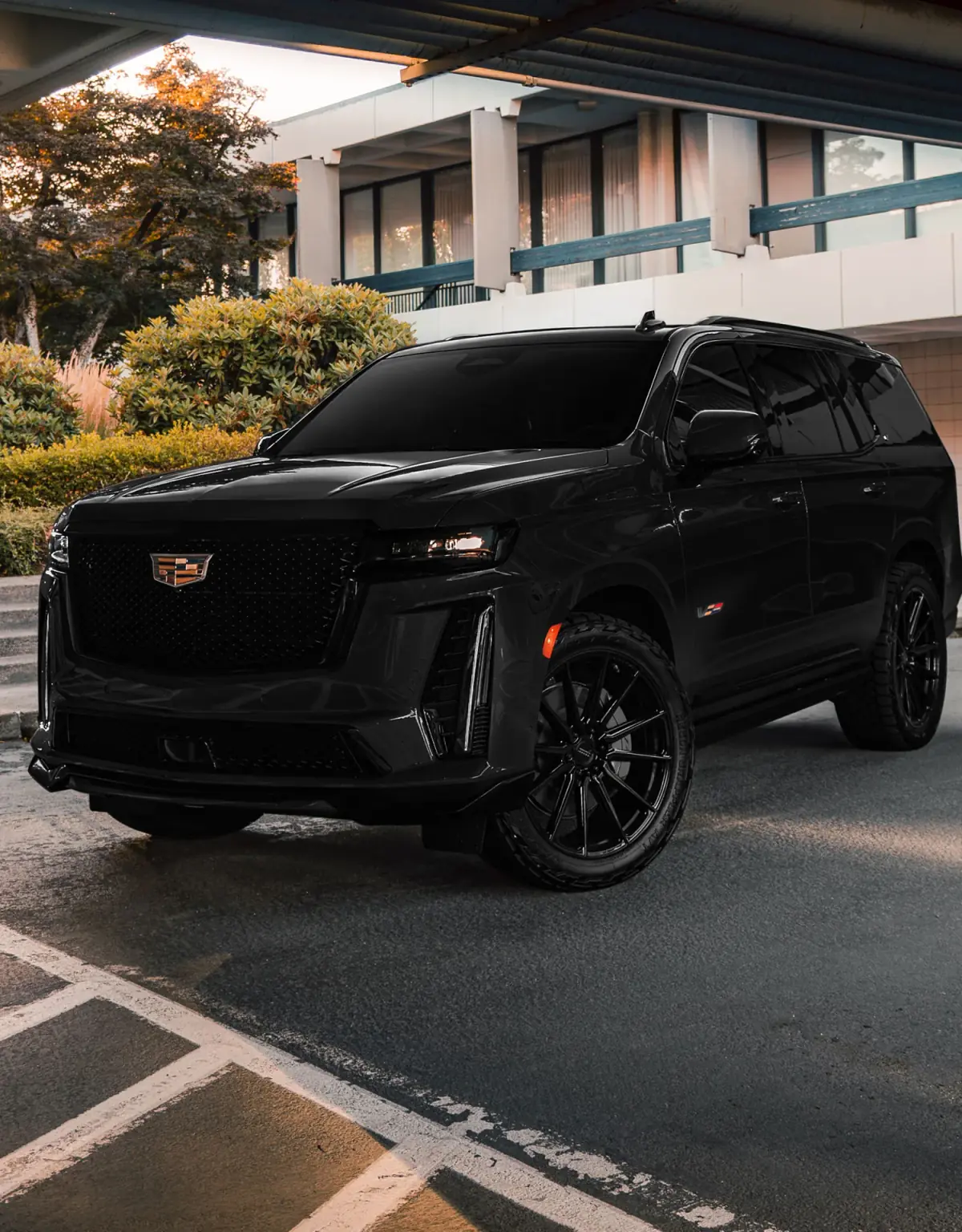
Cadillac builds the Escalade with available four-wheel drive through a single-speed transfer case, and Mercedes replaced the Sprinter's old 4x4 with torque-on-demand all-wheel drive splitting power up to fifty-fifty. Capable platforms, both. Neither replaces the tire budget or the route call.
The $500 misunderstanding
Skipping posted chain requirements costs up to $500 in Washington, and manufacturer advice against chains on certain models does not excuse compliance; the state says so explicitly. A professional fleet resolves that tension before winter, with fitments and equipment chosen so law and vehicle never argue.
Why forums stay confused
Every winter, threads ask whether AWD is enough and collect a hundred contradictory anecdotes, because the honest answer is conditional: enough for what road, on what tires, under whose judgment. The question this page answers instead is simpler: what does the prepared version look like.
03 The Morning List
What Gets Checked Before
A 4 A.M. Camas Pickup?
The list is federal before it is ours. Under 49 CFR 392.7, a commercial vehicle may not move unless the chauffeur is satisfied the service brakes, parking brake, steering, lights and reflectors, tires, horn, wipers, mirrors, and emergency equipment are in working order, and the companion rule requires reviewing the last inspection report before driving. Winter adds the seasonal layer: tread gauge, chain kit, washer fluid rated for ice, and a cabin warmed before the first passenger touches a door handle.
Want to hear the whole checklist recited by a human? Dispatch enjoys the question: (503) 706-8662.
The overlooked item
Training materials agree the most commonly skipped inspection item is the emergency kit, the extinguisher and warning triangles nobody expects to use. Winter is precisely when that kit earns its space, so on our morning list it moved from last to third.
The night-before half
A 4 a.m. winter pickup is really inspected at 9 p.m.: fuel, fluids, tires, and forecast reviewed with the assignment, so the morning check is confirmation rather than discovery. Anything found at 9 p.m. has a solution; the same finding at 4 a.m. has an apology.
The vehicle assignment call
Marginal mornings move east-county assignments to the SUV, full stop; the sedan keeps the valley floor and the Sprinter's group runs get the earliest staging so nothing is rushed on cold pavement. Assignment is the quietest winter tool an operator has, and the cheapest.
The grade decision
Some ice mornings the right professional answer is a meeting point at the bottom of the hill, agreed the night before, and the city's own winter closure practice on the steepest streets backs that judgment. Saying no to a grade is not service failure; driving a passenger onto one would be.

04 The Booking
What Does Winter Change
About Your Camas Booking?
Less than you would think, which is the point of the preparation. Rates hold: the S90 at $110 per hour, the Escalade ESV at $135, the Sprinter at $165, with a typical airport transfer near two booked hours. What changes is invisible margin, earlier staging on forecast mornings, the SUV taking assignments the sedan would carry in June, and pickup windows built with the season in them. Gorge-facing trips east of town inherit the chain-carry corridor's equipment rules automatically, and the toughest mornings get a phone call, not a surprise. The PDX airport shuttle for groups page covers the Sprinter tier for full crews.
No weather surcharge
The rate on a snow morning is the rate on a dry one. Weather risk is an operations problem we solve with equipment and staging, not a pricing event passed to the passenger, and that policy is worth exactly as much as it costs you: nothing.
The honest cancellation
A storm big enough to close the route is big enough to cancel without penalty, and the call happens as early as the forecast allows so you can work the airline side of the problem. Winter service is judgment shared honestly, in both directions.
Gorge trips, equipped
Winter runs east toward the Gorge, ski charters included, roll under the commercial corridor's standing equipment rules, and our Gorge charter page carries the touring side of that work. The airport side stays boring by design.
Ask the operator questions
Any company quoting a winter Camas run should answer three questions without pausing: what is on your tires, where are your chains, and who decides a grade is a no. This page is our three answers, in writing, with the statutes attached.
Frequently Asked
Questions, Answered.
Does AWD really make a difference in snow?
For getting moving, yes; for turning and stopping, far less than people assume. Tire-industry testing is blunt that all-wheel drive does little to aid braking on ice versus a two-wheel-drive car, and that worn or summer tires defeat any drivetrain. The honest ranking is tires first, judgment second, drivetrain third.
Which is better for snow AWD or 4WD?
A true 4WD system with a transfer case holds an edge in deep snow and on sustained grades, while modern on-demand AWD is quicker to live with day to day. On a maintained east-county road with proper traction tires, either serves; on an unplowed grade, the vehicle matters less than the operator's decision about whether to climb it.
Do you still need chains for 4WD?
In Washington, sometimes yes. The all-wheel-drive exemption from chains-required signs only applies when all wheels are in gear, the vehicle wears approved traction tires, and chains for one drive axle are physically carried in the vehicle. At the highest restriction level, everyone chains up, and ignoring a posted requirement risks a $500 fine.
Are Mercedes Sprinter vans good in snow?
The current platform is far better than its reputation: Mercedes replaced the old 4x4 option with a torque-on-demand all-wheel-drive system that can split power up to fifty-fifty between axles while keeping the same ground clearance. As with every vehicle in this guide, the tires and the operator decide more than the badge does.
What are the 7 steps for a pre-trip inspection?
Step counts vary by trainer, but the federal rule behind them names the substance: a commercial vehicle may not be driven unless the chauffeur is satisfied that service brakes, parking brake, steering, lights and reflectors, tires, horn, wipers, mirrors, and emergency equipment are all in working order, and has reviewed the last inspection report. That list is our morning, every morning.
Do the chains and traction tires show up on a Camas limo bill?
No. Winter equipment is our overhead, not a line item: rates hold at $110 per hour for the Volvo S90, $135 for the Escalade ESV, and $165 for the Sprinter, all-in with the 20 percent service fee included. Hourly bookings carry a three-hour minimum, Camas airport transfers are quoted firm at booking, and gratuity is optional, never tacked on. The tires cost us plenty; they cost you nothing.
How much notice does a storm-season Camas limo pickup need?
Twenty-four to 48 hours covers a standard Camas booking; give holiday weeks and forecast storm windows longer, since marginal mornings are exactly when the SUV assignments fill first. Same-day requests are worth a call to (503) 706-8662 and run subject to availability. Booking early is what buys the night-before vehicle check and the earlier staging this page describes, margin no last-minute request can add.
About the Author
Ilyas Khairi runs Marquee Chauffeur under Portland Bureau of Transportation certification held since 2018, with $1 million in commercial liability and W-2 chauffeurs on payroll. The winter file in this guide is the one his own east-county assignments run on, published because the clients who ask the tire question are the ones every good operator wants.
Verified Google Reviews
What Portland clients say about Marquee Chauffeur.
I spent six hours touring the Columbia River Gorge with the owner of this service, and I was really impressed with his professionalism, attentiveness, and local knowledge. As he says, they really are like a chauffeur/concierge, not just taking you from one place to another but providing a full experience. I look forward to riding with them again on my next trip.
Edris — has absolutely hands down have to be the best driver ever. I would absolutely recommend his service! He's so professional, so efficient. On time and so respectful!
These guys are terrific. Two thumbs up. Found them online and got excellent personal service. Used them to get from PDX to about two hours away …. And then back to PDX a few days later. On time. Super professional drivers. Vehicles in spectacular shape. Brand new. They will be out go to service. We recommend them highly.
Marquee Chauffeur holds a 5.0 rating across 198 Google reviews. Read every review on Google.
Reserve Your Chauffeur
Reserve a Portland
Chauffeur Now.
Ride with the operator who prepared in October. Call Marquee Chauffeur at (503) 706-8662, available 24/7. Camas winter airport bookings run at the same locked rates as July, Volvo S90 at $110 per hour, Escalade ESV at $135, Sprinter at $165, with seasonal staging built into the pickup window, FlightAware tracking, and a 30-minute arrival grace window (45 on international arrivals), under Portland private-for-hire permitting since 2018 with $1 million in commercial liability.